Originally reported by DeepChao TechFlow on November 10, 2026, at 20:53 (UTC+8).
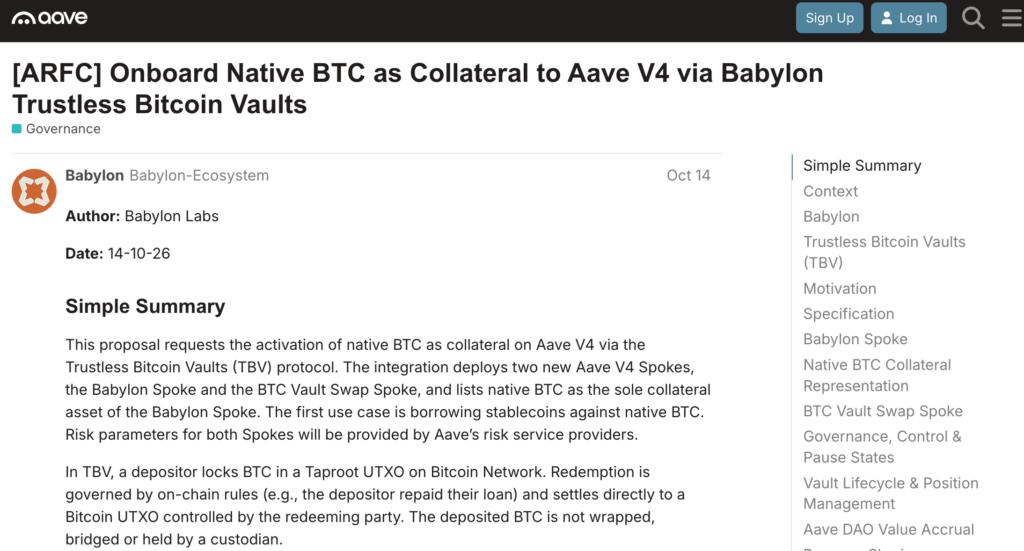
Aave DAO voted unanimously in favor of an ARFC-stage proposal to accept native Bitcoin as collateral in Aave V4 through Babylon’s trustless Bitcoin vaults, according to Babylon’s November 9 announcement. This was not the final on-chain approval or a live lending market: the proposal still had to reach an AIP execution vote. Its stated mainnet target was the end of 2026, with participation and capacity initially limited.
The proposal was first submitted in May and passed a June community temperature check with 299,743 AAVE in favor and none against. Aave founder Stani Kulechov expressed support on the forum when the formal proposal appeared on October 14. TechFlow’s earlier count found that 73 of Aave’s 74 binary Snapshot proposals that year had passed.
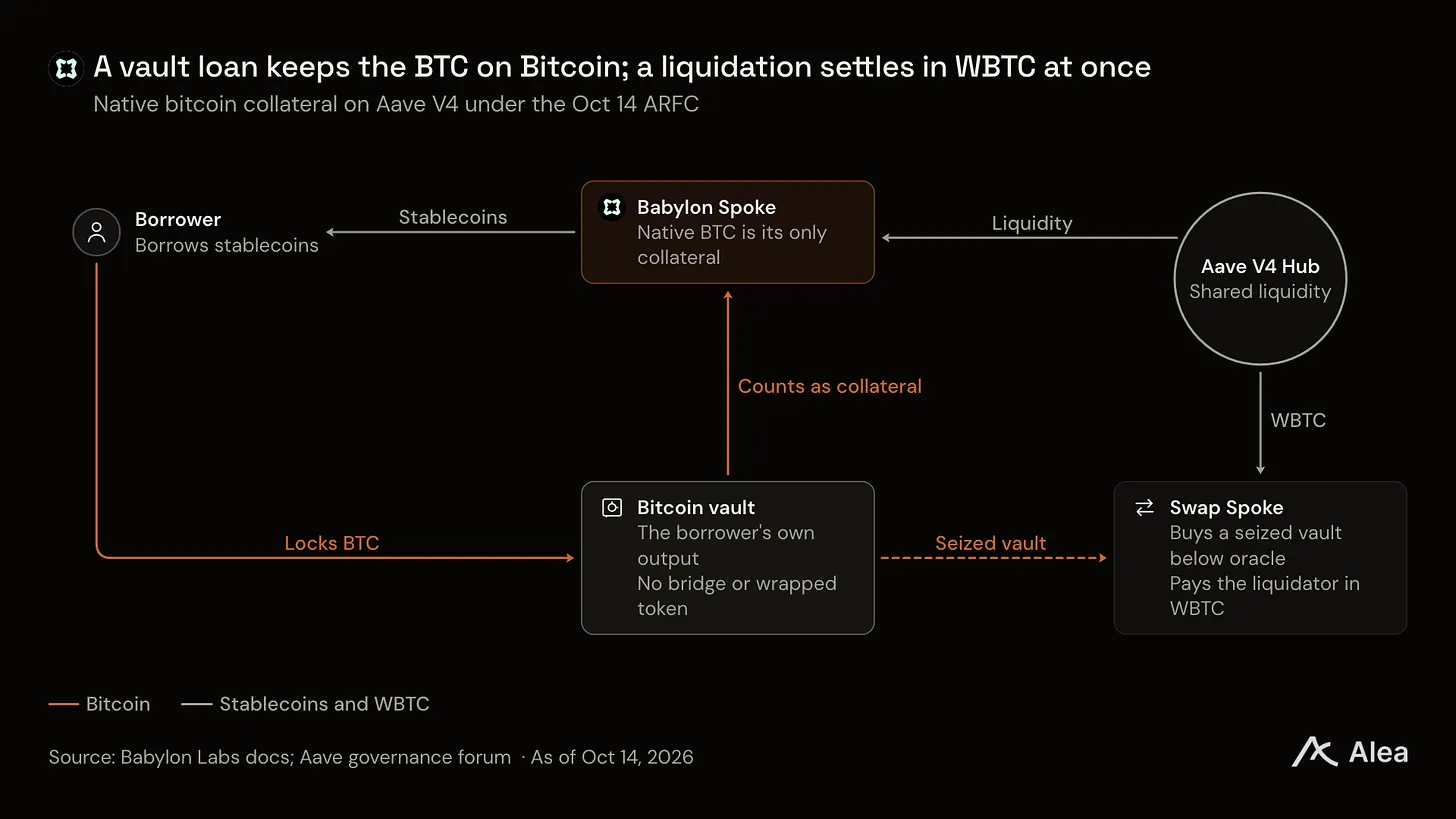
How the proposed collateral would work
Under the design described on Aave’s governance forum, a borrower would lock BTC in a Taproot vault on Bitcoin while retaining control of their private keys. A non-transferable accounting token representing the locked amount would serve as collateral in Aave V4, allowing borrowing in assets including USDT and USDC without first wrapping or bridging the BTC. This differs from Aave collateral such as WBTC and cbBTC, whose underlying Bitcoin relies on custodians, as Cointelegraph noted. TechFlow reported that Aave had already deployed a dedicated LBTC market; this proposal concerns unwrapped native BTC.
Risk adviser LlamaRisk specified a 78% collateral ratio and a maximum 5.55% liquidation bonus. PANews reported that the collateral ratio and borrowing rate were comparable to those for WBTC and cbBTC in Aave V4’s core market. Alea Research relayed Babylon’s estimate of 3%–5% annualized borrowing costs, versus a cited 9%–16% range at centralized lenders. Those are estimates and comparisons, not realized rates for this proposed market. TechFlow put Bitcoin staked through Babylon at about 40,481 BTC at the end of the third quarter, held on Bitcoin through scripts.
Limits, fees and the remaining dependency
The proposal set an initial 300 BTC collateral cap. It allocated approximately $21 million in credit from Aave’s core pool: $8 million each in USDT and USDC, $2 million each in USDG and RLUSD, and $1 million in GHO. Any later increase would require Aave DAO approval. For scale, Alea Research estimated Aave V4’s effective loans across the protocol at roughly $310 million in September.
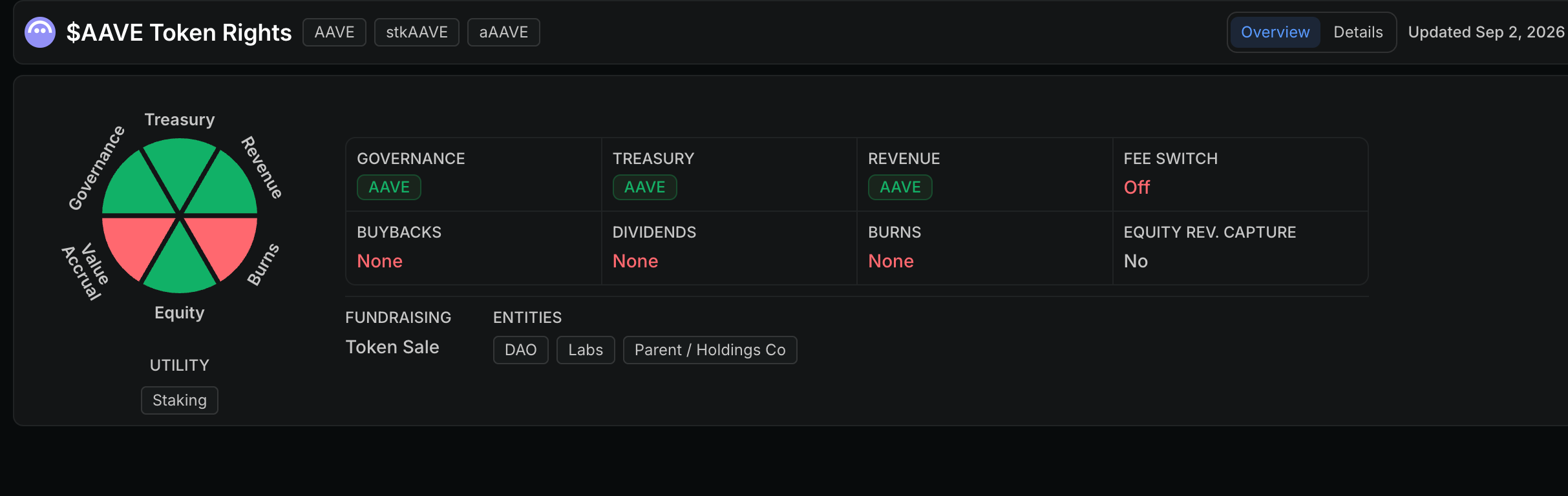
Only two revenue sources count toward the proposed sharing arrangement: Aave’s liquidity fees from interest paid by borrowers in this market, and liquidation fees. Aave DAO would receive the first $500,000 each year. In the $500,000–$2 million tier, the split would be 78% to Aave DAO, 18% to Babylon and 4% to buybacks; for revenue above $6 million, it would be 61.5%, 31.5% and 7%, respectively. Buybacks would purchase 85% AAVE and 15% BABY, with the purchased tokens divided equally between Aave DAO and the Babylon Foundation.
In Alea Research’s hypothetical $10 million annual-revenue case, it calculated approximately $6.92 million for Aave DAO, $2.52 million for Babylon and $560,000 for buybacks, including about $84,000 spent on BABY. Alea described this as BABY’s first proposed value channel tied to borrower interest. For context, an Aave governance proposal passed in March reduced AAVE’s existing annual buyback budget from $50 million to $30 million. Alea estimated BABY issuance at about 1.58 million tokens daily, worth roughly $7 million annually at third-quarter prices.
The BTC collateral would remain on Bitcoin, but the proposed liquidation process would still depend on WBTC: a liquidator would buy a seized vault using WBTC, after which an arbitrageur could redeem its BTC on Bitcoin. The proposal also assigned emergency pause authority to a 3-of-5 multisignature group involving Aave Labs, LlamaRisk and Babylon. Pausing and resuming would have no timelock; a pause would block repayments as well as liquidations. The group would not have authority to move users’ BTC.
At the time of the report, Alea Research said Babylon planned to submit BABY token-economics changes to governance before the end of November, aimed at directing more new issuance toward the vault business. It also noted that approximately 2,999 BTC staked under Gate’s custody was due to mature around November 30; Babylon’s staking total could change if that stake was not renewed. Neither a token-economics change nor the proposed lending market’s resulting buybacks was assured.
Source: techflowpost.com (originally published 2026-11-10 20:53 UTC+8)