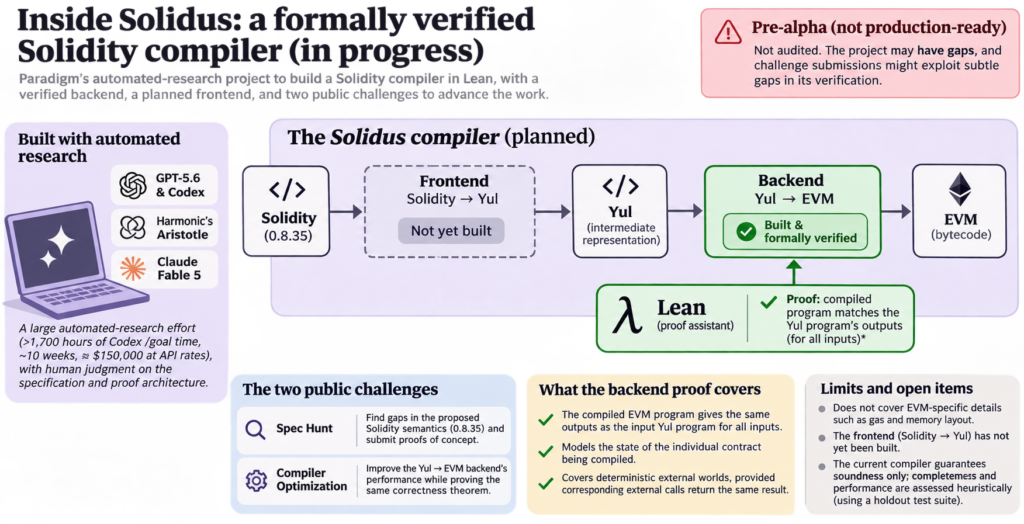
As of its July 24, 2026 announcement, Paradigm’s Solidus was a pre-alpha project, not a production-ready Solidity compiler. Its Yul-to-EVM backend had been built and formally verified, while the Solidity-to-Yul frontend had not yet been built. Paradigm also introduced two public challenges: one to find gaps in its proposed Solidity semantics, and another to optimize the backend without dropping its correctness proof.
What the proof covers
Solidus is being implemented in Lean, a programming language and proof assistant. Its completed backend takes Yul—an intermediate representation used by the Solidity compiler—and produces EVM programs. Paradigm says it has proved that the compiled program gives the same outputs as the input Yul program for all inputs, apart from EVM-specific details such as gas and memory layout.
That claim has boundaries. The semantics model the state of the individual contract being compiled, although the compiler supports external calls. The proof covers possible deterministic external worlds under the condition that corresponding external calls return the same result.
A complete Solidity-to-EVM compiler would also need a frontend. Paradigm said it had drafted formal semantics for Solidity 0.8.35 to support that work, but expected the draft might diverge from Solidity’s behavior. The Spec Hunt challenge asks contributors to find such divergences and submit proofs of concept. Submissions are tested with Foundry and reviewed by an AI agent, with human review available if needed.
The separate Compiler Optimization challenge targets the existing Yul-to-EVM backend. Paradigm said its compiler produced almost three times as much bytecode as solc on its test suite. Entrants must improve performance while proving the same correctness theorem. Paradigm cautioned that the current compiler guarantees soundness only; completeness and performance are assessed heuristically using a holdout test suite.
Why Paradigm is opening the work
Paradigm described Solidus as an automated-research effort involving more than 1,700 hours of Codex /goal time—about 10 weeks—and estimated roughly $150,000 at API rates. It said no human read or wrote a line of Solidus code, but humans still made judgments about the evolving specification and proof architecture. Paradigm identified GPT-5.6 and Codex as principal contributors and said it also used Harmonic’s Aristotle and Claude Fable 5.
Formal verification can establish that a compiler meets a stated property, but it cannot by itself ensure the property captures every behavior users expect. Paradigm warned that Solidus had not been audited, was not production-ready, and that challenge submissions might exploit subtle gaps in its verification. The challenges are intended in part to expose those gaps—not to demonstrate that the planned compiler is already safe to deploy.