Bitcoin mining pool operator Braiins said an attacker redirected traffic between miners and their pools in 24 incidents from Nov. 7 to 20, 2026. The machines kept running, but the attacker could claim credit for their work. Braiins shared its findings on Nov. 25; Cointelegraph published its coverage on Nov. 26, 2026, at 05:22:19 UTC+8.
The early incidents mainly affected sites in Brazil and Argentina. On Nov. 20, four attacks each affected between 1,050 and 1,600 mining sites, mostly in Europe. Braiins described the episodes as brief, but said the computing power affected in a single attack grew nearly elevenfold over two weeks, from under 175 petahashes per second to 1.9 exahashes per second (EH/s). At its peak, that represented about 0.19% of Bitcoin’s total hashrate, which MineOrNot estimated at 1,016 EH/s on Nov. 20.
Why miners might not notice
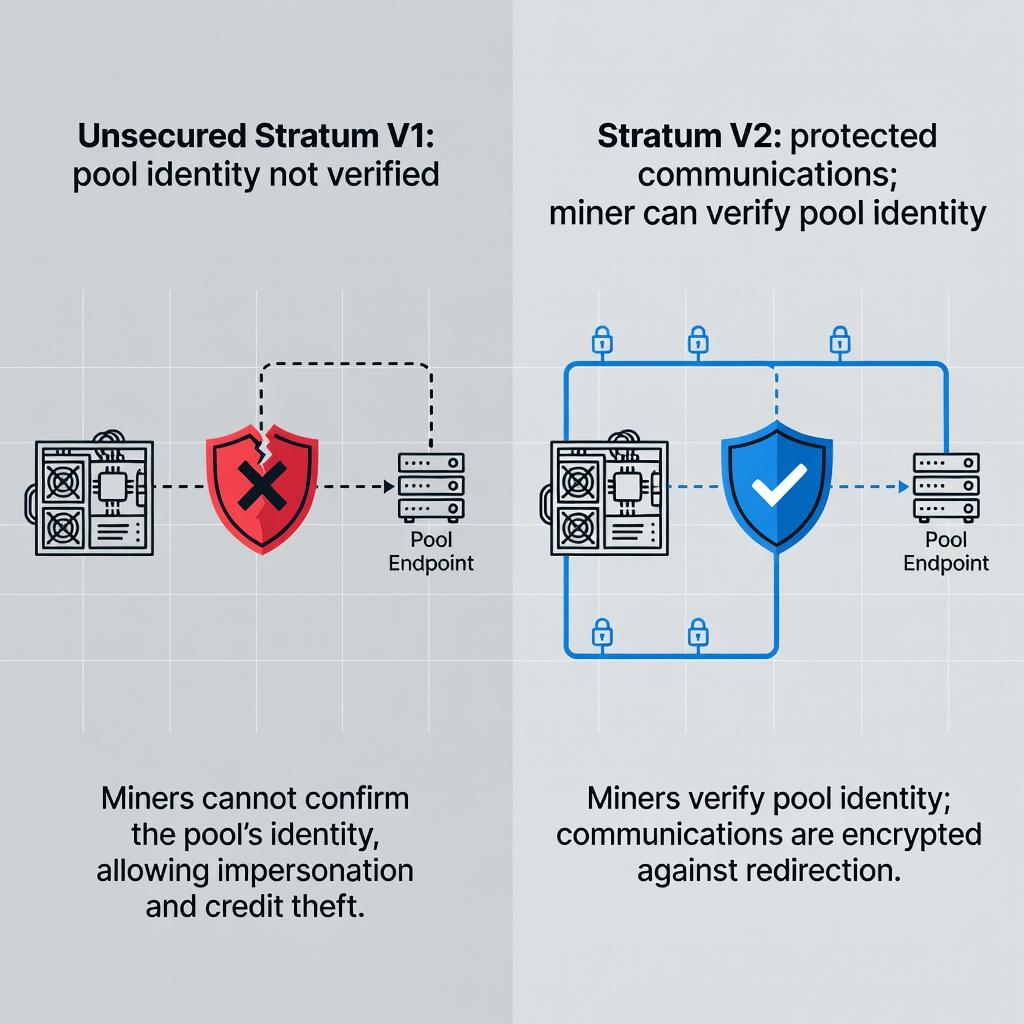
Stratum V1, introduced in 2012, lets mining machines communicate with pools. In its unsecured form, it gives a miner no way to verify that the pool on the other end is the intended one. Braiins said neither its pool nor the affected machines were hacked directly. With the connection redirected, a miner could keep paying for electricity without realizing someone else was getting credit for the work.
Braiins did not disclose how much money miners may have lost or specify whether the affected sites were large commercial farms or smaller independent operations.
What a secure pool connection changes
Braiins said the vast majority of Bitcoin’s computing power still used unsecured Stratum V1 connections. In a Nov. 23 review of the largest pools, it found that most offered only unsecured V1 connections.
The company urged miners to switch to Stratum V2, which protects communications and lets mining software verify the pool’s identity. For miners unable to upgrade, Braiins identified a V1 alternative with two requirements: the pool must offer an encrypted connection, and the mining software must be able to verify the pool’s identity.
A separate incident involving Luxor Technology, reported on Nov. 16, affected a little over a dozen customer accounts. In that case, attackers exploited a weakness in Luxor’s Commander management software to redirect computing power to the OCEAN pool. Luxor said it fixed the issue within two hours of detecting the unauthorized changes and promised to compensate affected customers in full.