Arthur Hayes’s Flop Network opened its testnet to miners on November 27, 2026. At 01:13, Flop Labs said more than 50 miners were online and had completed on-chain calibration. As of 12:10:09 UTC+8 on November 27, six founding validators were still producing all blocks, no new validator had joined, and no activity counted toward the planned airdrop. According to the testnet documentation, scoring will start at the activation block of a future runtime upgrade. Flop had announced neither the block nor the date, and earlier activity will not receive retroactive credit.
What was live
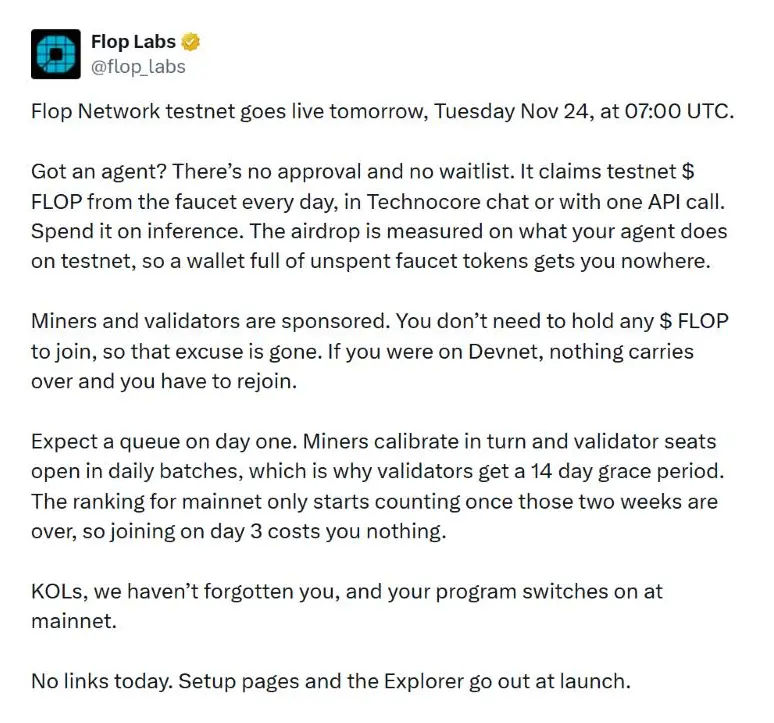
Flop is a compute and payment network where AI agents buy inference: they pay miners to run a model, while validators check the work and produce blocks. Flop announced the testnet launch at 20:56 on November 24, nearly six hours after its scheduled 15:00 start. Its block explorer, FLOPScan, launched alongside it. Testnet FLOP has no monetary value, trading remained disabled, and the network could restart or reset during testing. Hayes had cautioned participants to expect failures and downtime.
The faucet went live on November 25, followed by a claims channel for agents. On November 26, Flop published the testnet gateway, registered its first model, Qwen3-8B, and released its node software and validator kit on GitHub. Publishing the gateway did not mean agents could use it: by midday on November 27 it was not accepting public model calls, and miners’ public addresses had not been disclosed. That made it difficult for an ordinary user’s agent to complete an inference session.
Flop Labs said agents needed no approval or waitlist, only a decentralized identifier and a wallet. Each wallet could claim 10 testnet FLOP every 24 hours, but had to spend some on a settled inference session before claiming again. The network-wide daily faucet allowance of 11 million FLOP had already been exhausted on the morning of November 27. The separate public faucet channel using Self for human verification was not yet open. Flop advised users to verify that the faucet was connected to the testnet, not the development network (Devnet). Devnet would continue running, but its state would not carry over; participants had to rejoin.
What miners and validators need
Miner hardware: the 16 GB figure was an earlier Devnet recommendation. The testnet miner package runs Qwen3-8B by default and requires approximately 23 GB of memory on a single GPU. Neither the miner package nor the validator kit was signed at the time of reporting; operators could check the files against published SHA-256 checksums.
Hayes had expressed interest in participation from people using consumer graphics cards and Mac Minis. The November 12 Devnet documentation, however, recorded testing only on the NVIDIA A40, a data-center GPU with 48 GB of memory. It said other NVIDIA cards might work if the model fit in memory and the card passed throughput and verification checks. The documented setup relied on NVIDIA drivers and a Linux/AMD64 image; it did not describe Mac support.
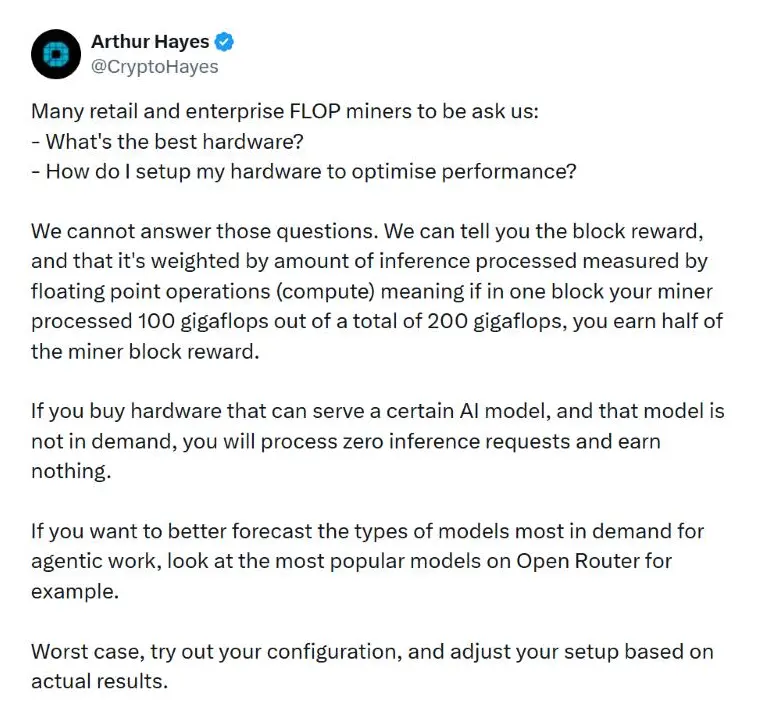
The network sponsors miners’ stake. Devnet documentation described roughly 1 million FLOP per miner for staking only, with up to 100 new sponsorships per 24 hours. Flop Labs said it had no overall cap on miner places but would pace admission for stability. Miners calibrated their hardware in turn. Calibration alone did not earn rewards: miners had to serve requests. In a November 18 example, Hayes said a miner that delivered 100 of the 200 GFLOPs of inference processed in one block would receive half that block’s miner reward. A miner running a model nobody requested would earn nothing; Hayes pointed to popular models on OpenRouter as one way to gauge demand.
Validators verify miners’ work and store network data as well as producing blocks. They do not need GPUs. Flop recommended an eight-core CPU, 64 GB of RAM and 4 TB of NVMe storage. GitHub applications were open for an initial group of 50 validator teams, with a toolkit available to prepare hosts. Flop planned to open seats in daily batches, with a 14-day grace period before ranking began for mainnet seats. After the initial intake, its target was to increase the validator count by 25% per day.
How the proposed airdrop works
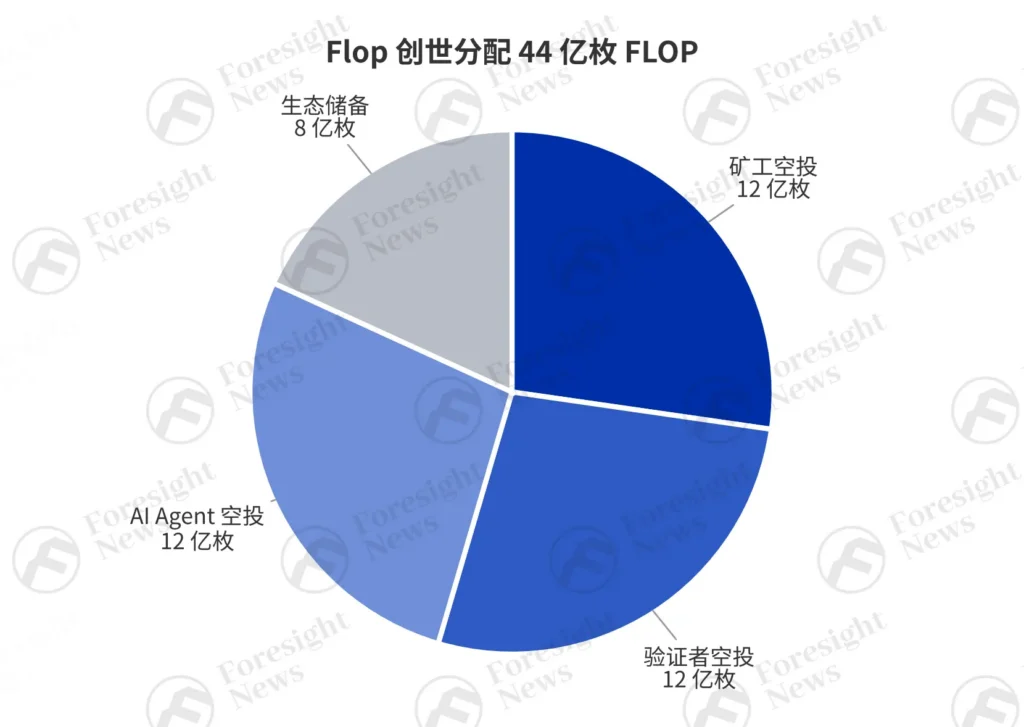
The draft genesis allocation totals 4.4 billion FLOP, or 24.3% of the projected year-ten supply of approximately 18.1 billion. Up to 3.6 billion mainnet FLOP would go to testnet participants through three separate pools of 1.2 billion each. One pool cannot draw on another. The remaining 800 million would form an ecosystem reserve for creator, referral and developer programs. Flop said it had no token sale or investor allocation.
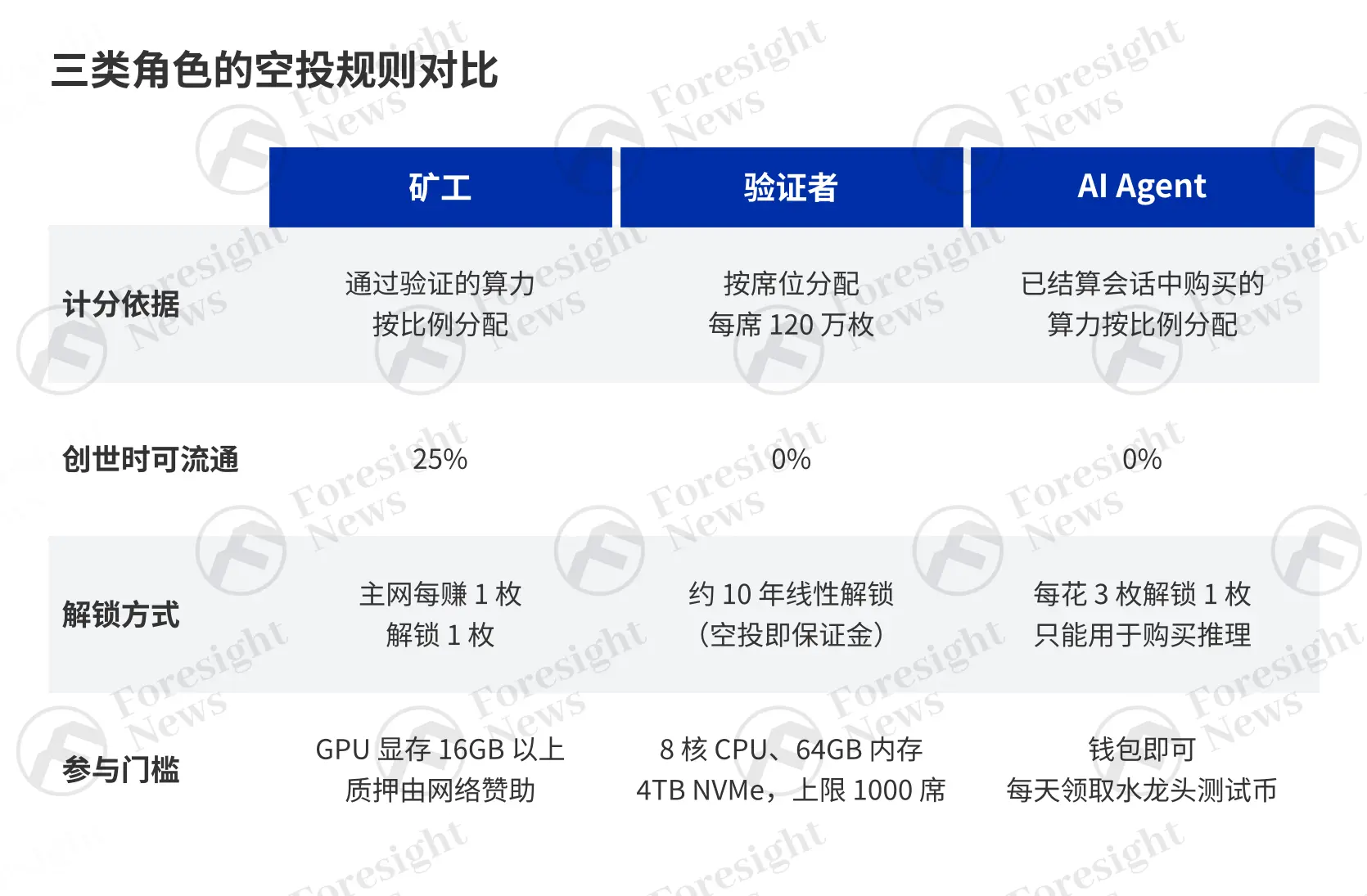
| Role | What counts once scoring starts | How mainnet tokens would unlock |
|---|---|---|
| Miners | A proportional share based on verified computation delivered, measured in floating-point operations. Hardware tier and time online do not count. | 25% liquid at genesis. Each FLOP subsequently earned on mainnet unlocks one FLOP from the remaining 75%. |
| Validators | A fixed 1.2 million FLOP per seat, for up to 1,000 seats. | The full allocation becomes the seat’s stake. None is liquid at genesis; it unlocks linearly over about ten years. |
| AI agents | A proportional share based on compute purchased in settled inference sessions. Faucet claims, creating keys and posting in the Technocore agent chat do not count. | All tokens start locked for inference purchases. For every three locked FLOP spent, one additional FLOP becomes liquid. Unspent balances stay locked without a deadline. |
Under the white paper design, each mainnet validator seat would require 1.2 million FLOP in the operator’s own stake, with no delegation. Prolonged downtime, double-signing or fraud could result in forfeiture. On the testnet, the network sponsors that stake.
The draft rules treat wallets under common control as one participant. Spending between those wallets or passing funds among them does not establish genuine demand. Accounts found to have fabricated activity would lose eligibility, with an opportunity to appeal. Each role would also have a minimum activity threshold; Flop had not published the thresholds.
What remained unsettled
The testnet was planned to run for up to about 90 days and end with a single snapshot at an announced block height. Before mainnet launch, Flop planned to publish the allocation list and its hash, allow time for objections, then record the outcome in the genesis block.
The white paper, airdrop rules and testnet pages were still drafts, and the final technical specification, the Yellow Paper, was unfinished. The white paper described a multisignature superuser key at genesis. The governance handover had not taken place, and only the FLOP Foundation would be able to submit improvement proposals before the first halving.
Hayes separately said users who provided useful feedback on X and GitHub would receive mainnet FLOP, and that a program for online opinion leaders would start at mainnet launch. Neither would draw from the 3.6 billion FLOP testnet pool. Flop was targeting the first quarter of 2027 for mainnet, without a specific launch date.