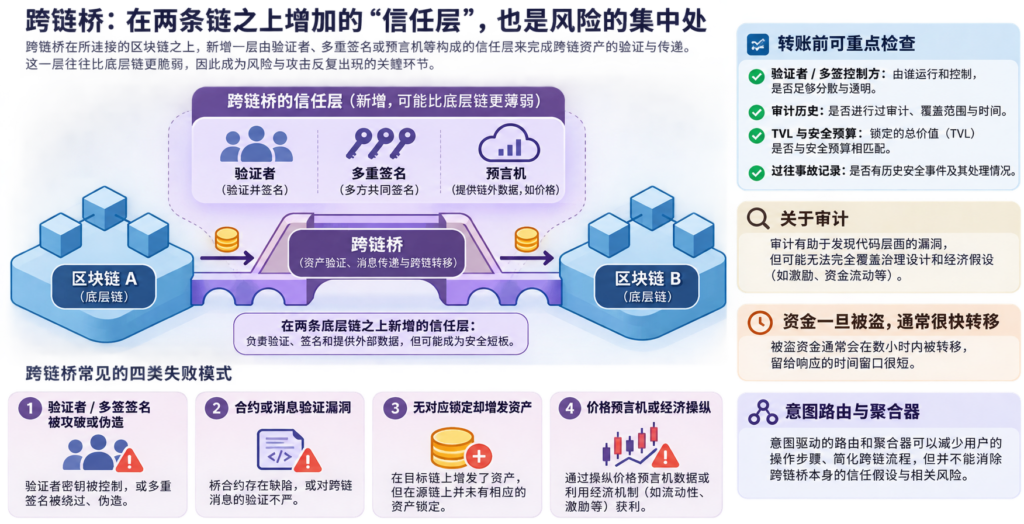
In an article published on November 17, 2026, the author argues that cross-chain bridges add a trust layer on top of the chains they connect. That layer—often involving validators, multisignature signers or oracles—can be weaker than the underlying chains.
The article groups recurring failures into four types: compromised or forged validator or multisignature signatures; flaws in contracts or message verification; assets issued without a corresponding lockup; and price-oracle or economic manipulation.
Audits can help find code vulnerabilities, the author notes, but may not fully cover governance and economic assumptions. The article also warns that stolen funds are typically moved within hours.
Before transferring assets, the author recommends checking who controls the validators or multisignature setup, the bridge’s audit history, its total value locked relative to its security budget, and its record of past incidents. Intent-based routing and aggregators may reduce the number of steps a user takes, but they do not remove the underlying trust assumptions.