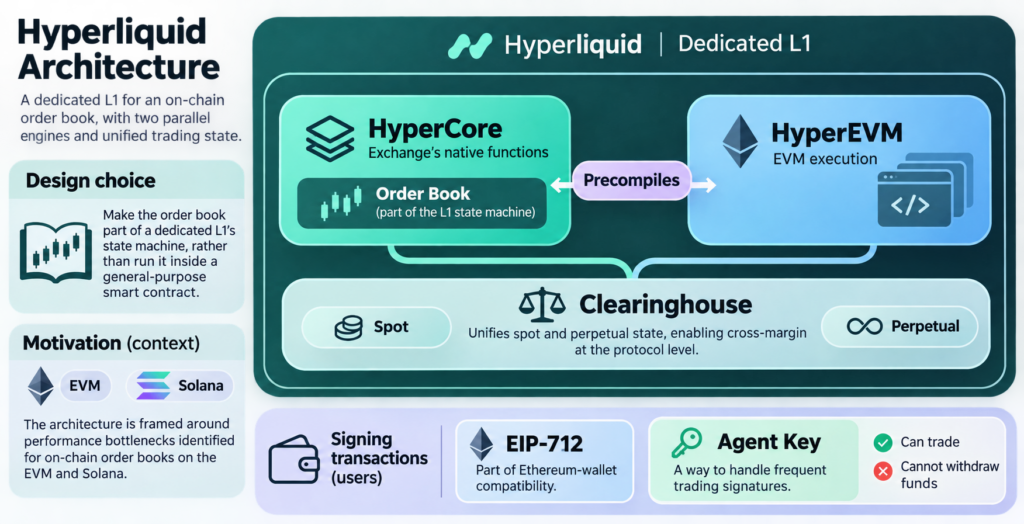
A November 16, 2026 explanation of Hyperliquid’s architecture describes its central design choice: make the order book part of a dedicated L1’s state machine rather than run it inside a general-purpose smart contract. The article frames that choice around performance bottlenecks it identifies for on-chain order books on the EVM and Solana; it provides no comparative performance figures.
The design has two parallel engines. HyperCore handles the exchange’s native functions, while HyperEVM supports EVM execution and interacts with HyperCore natively through precompiles. A Clearinghouse unifies spot and perpetual state, enabling cross-margin at the protocol level.
For users signing transactions, the article describes EIP-712 as part of Ethereum-wallet compatibility and Agent Keys as a way to handle frequent trading signatures. Its stated boundary for an Agent Key is narrow: it can trade, but it cannot withdraw funds. The account explains the architecture; it does not establish adoption or performance outcomes.