Reported November 28, 2026, at 07:40 UTC+08:00.
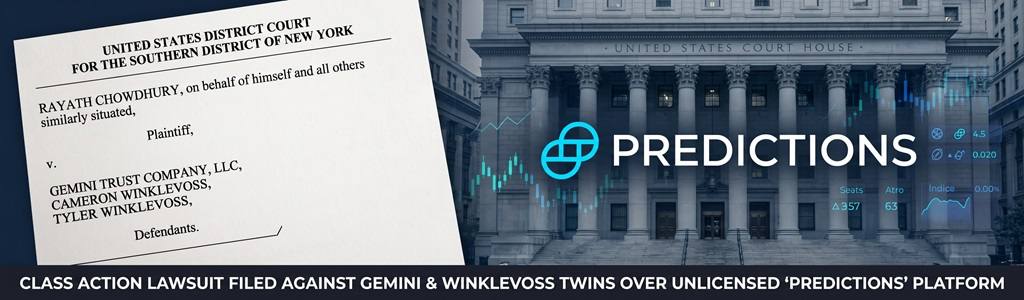
New York resident Rayath Chowdhury filed a proposed class action on November 25, 2026, alleging that Gemini Predictions operates as an unlicensed sportsbook and lets people aged 18 to 20 place sports bets. Chowdhury says he began wagering on the platform’s sports event contracts around May 19 and lost money.
The complaint, filed in the U.S. District Court for the Southern District of New York, names Gemini Space Station Inc., Gemini Titan LLC, Gemini Olympus LLC, Winklevoss Capital Fund LLC and Gemini co-founders Cameron and Tyler Winklevoss. The court had not examined the allegations or certified a class at the time of reporting. The claims remain unproven.
Why the complaint challenges the contracts
New York, where Gemini is headquartered, requires sportsbooks to hold a state license. Chowdhury alleges that no Gemini affiliate has ever held a license from the New York State Gaming Commission. He contends that Gemini has called sports bets “event contracts” since at least January 8, 2026, to offer them in jurisdictions that prohibit online sports betting. In his account, terms such as “trading” and “predictions” obscure the nature of the activity.
The platform’s offerings include point spreads on college baseball and basketball games. In September 2026, it introduced NFL parlays under the name “combos.” Public reports cited in the complaint estimate that more than 329 million contracts traded on Gemini Predictions between its December 2025 launch and October 21, 2026. The cumulative count reached 100 million in May and 225 million by mid-August.
Chowdhury alleges that the platform is accessible to users aged 18 to 20 in all 50 states, although people in that age group generally cannot legally bet on sports in New York and other states. He says Gemini targets those users through social media advertising, cash promotions and endorsements from the founders.
Who could seek recovery
Chowdhury proposes a nationwide class, a New York class and subclasses in 29 other states and the District of Columbia. He seeks to recover money users wagered and asks for a jury trial, an accounting of bets, restitution, injunctive relief and treble damages.
The complaint brings five counts under New York law. Two invoke Sections 5-419 and 5-421 of the General Obligations Law, which allow bettors to sue to recover losses on illegal wagers. Two more cite the General Business Law’s prohibitions on deceptive acts and false advertising, under Sections 349 and 350. The fifth alleges unjust enrichment. The court’s next step was to consider whether the complaint could proceed and whether to certify the proposed classes.
Chowdhury argues that the Winklevoss brothers jointly own, fund and oversee the Gemini entities as a single enterprise. He alleges that hosting the service on Gemini while keeping equity and guarantees in Winklevoss Capital Fund directs revenue to the founders. In May 2026, the fund paid approximately 1,258 bitcoins for $100 million in new Gemini shares, raising the brothers’ beneficial ownership to roughly 65.1% of the company’s Class A shares.
Earlier state action
This was Gemini’s second gambling-related case in New York in 2026. On April 21, New York Attorney General Letitia James sued Gemini Titan, alleging that it operated an unlicensed wagering business. Connecticut’s consumer protection regulator issued a cease-and-desist order in September, followed by Ohio’s casino control commission in October.
Separately, Gemini’s third-quarter 2026 revenue fell 19% year over year to $40.9 million. Asset manager VanEck also decided to discontinue custody and settlement agreements with Gemini for three exchange-traded funds.