Originally published November 10, 2026, at 10:59 UTC+8. This is a catch-up on the plans and testnet status reported at that time, not a report of subsequent deployment.
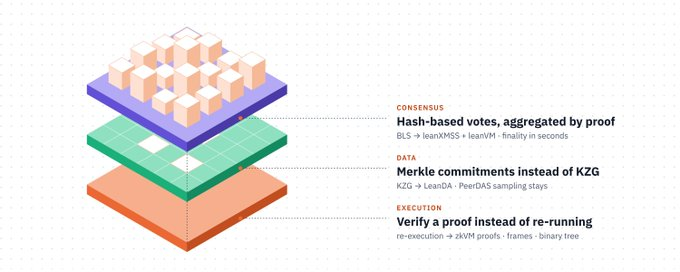
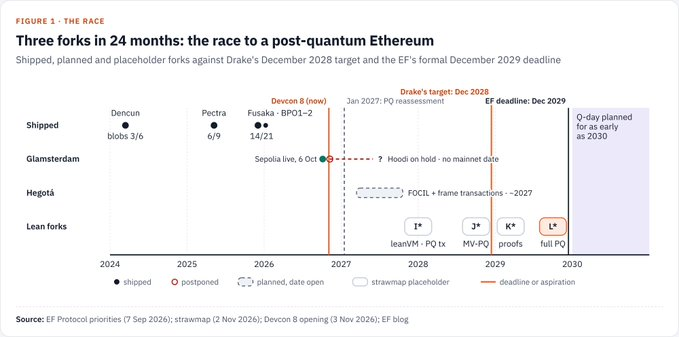
At Devcon 8 in Mumbai, Ethereum Foundation researcher Justin Drake set out an ambition to complete Ethereum’s quantum-resistant and “post-AI” transition by December 2028. The article reports that this would require three hard forks in the 24 months after Glamsterdam. It is a more aggressive target than the Foundation’s published December 2029 plan, which was not due for reconsideration with outside experts until January 2027. Neither date meant the transition had been deployed.
The immediate difficulty was Glamsterdam. According to the article, the upgrade had been running on the Sepolia testnet since October 6, 2026, but was withdrawn from a second testnet on October 22. A proposed gas repricing had disrupted assumptions used by deployed contracts; the Hoodi testnet rollout was delayed, with no new Hoodi or mainnet date given. All Core Devs coordinator Nixo wrote that the issue would “very likely” push Glamsterdam’s mainnet launch into 2027.
Why the repricing matters
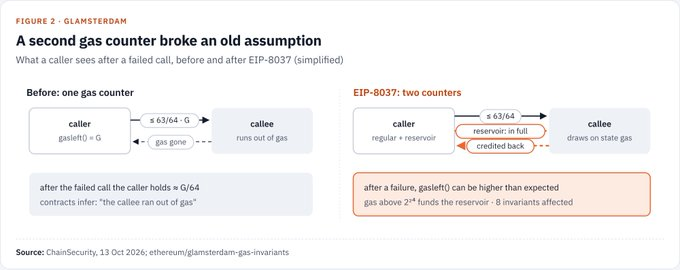
EIP-8037 proposed charging 1,530 gas per byte of new state to slow state growth. The article says this would raise the cost of writing a new storage slot from 22,100 to 110,020 gas and increase the cost of deploying a 24 kB contract by about eightfold. A separate state-gas reserve was intended to handle costs beyond a transaction’s gas limit.
ChainSecurity warned that this arrangement could let error-handling code finish in cases where it previously ran out of gas, bypassing checks against malicious interference. The Foundation listed eight broken invariants, while an All Core Devs summary counted 13 affected DeFi projects. Those were reported compatibility concerns, not evidence that EIP-8037 had taken effect on mainnet.
The dependency extends beyond Glamsterdam: the draft for Hegotá, the following planned fork, lists EIP-8037 as a requirement. Hegotá is intended to introduce frame transactions, which would let accounts define their own authorization methods—a route away from today’s ECDSA signatures without requiring a fork for every replacement scheme. It also includes FOCIL, a proposed transaction-inclusion mechanism intended to make censorship by a single block builder less effective.
The proposed sequence, and its limits
The roadmap described in the article places the leanVM proof system and quantum-resistant “lean” transactions in a later fork labelled I*. J* would add hash-based validator signatures and quantum-resistant data sampling—the Foundation’s proposed “minimum viable post-quantum” milestone. K* and L* would bring mandatory proofs and remaining Lean architecture changes. These are roadmap steps, not completed upgrades.
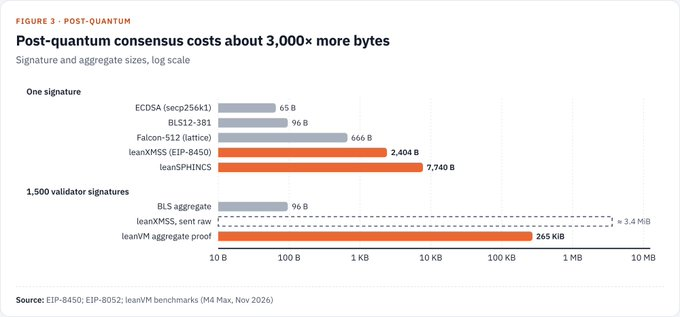
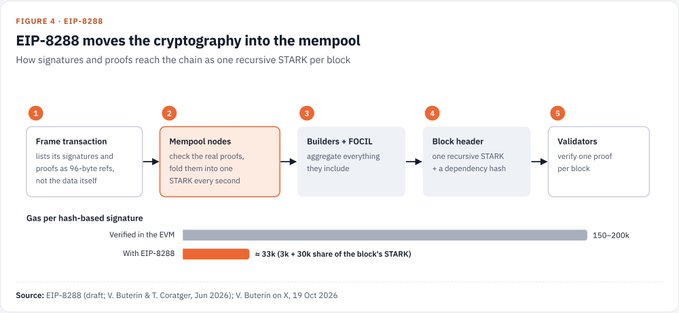
Signature size helps explain the engineering work. The article gives a proposed leanXMSS validator signature as 2,404 bytes, versus 96 bytes for BLS. Because hash-based signatures cannot be combined in the same way as BLS signatures, the proposed design uses proofs that the individual signatures were checked. EIP-8288, still a draft, would instead aggregate certain signatures and proofs while transactions are in the mempool, keeping the large underlying data out of blocks. Its STARK dependency support was only reserved in the draft, and key details remained undecided.
The article also qualifies claims about verification: while Drake announced end-to-end formal verification for leanVM, the reported Lean 4 work covered instruction semantics and constraints; the Rust implementation had undergone differential testing, and the soundness of recursive proofs remained an open question.
The schedule was therefore as significant as the cryptography. Three forks in 24 months would mean roughly one every eight months, while the article cited recent Ethereum fork intervals of 11, 14 and seven months. As of the original report, Glamsterdam’s repricing problem had left even the next step without a new testnet or mainnet date.
Source: panewslab.com (originally published 2026-11-10 10:59 UTC+8)